
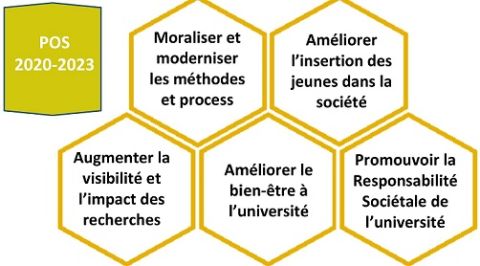
The first set of values, centered around critical thinking, emphasizes rigor and high standards in both training and research at the University, highlighting the professionalism of its various stakeholders. This set of values also underscores the ongoing concern for responsibility, ethical reflection in the actions of participants, sustainability, and a strong commitment to instilling these values in learners. It also points out that the human and social dimension, as a driver of change, a tool for continuous improvement, and a catalyst for progress, is a recurring concern at the University.
The second set of values, centered around creativity, expresses entrepreneurial values and the University’s propensity for innovation, proactivity, and initiative, with the presence of several clubs and its reputation as a "driving force" in various fields. This set of values also emphasizes the uniqueness of UMA and the fact that some of its programs are pioneering and/or unique in Tunisia, with a portion of the curricula in the arts. It also highlights the innovative potential of the research conducted and its impact on society.
The third set of values, centered around friendliness, expresses the University’s openness and proximity to its community, region, and, more broadly, the realities and needs of its socio-economic environment. It refers to the physical and material aspects of university life at UMA (space, greenery, aesthetics of the two campuses, conviviality among different groups, pleasant work environment in certain institutions, leisure activities, etc.) and extends to the aim of instilling a sense of sharing, inclusion, and interdisciplinarity in its students.
UMA follows the model of a public, multidisciplinary, modern, and responsible university serving an open, democratic, and prosperous society. It brings together a cohesive community strongly united by ethics and values of excellence and responsibility through training and research centered on human development, which sustainably contributes to scientific progress and the intellectual, cultural, and economic development of Tunisia.
UMA’s mission is to promote the acquisition and development of skills through education, training, learning, and research, providing youth with knowledge, energy, and constructive visions capable of changing the surrounding world and shaping the future. This mission is divided into three components: scientific, pedagogical, and societal.
In the scientific domain, UMA is a place for the production, intersection, dissemination, and significant sharing of knowledge, whether cutting-edge, fundamental, or applied, in the humanities, social sciences, experimental sciences, and technical fields.
In the pedagogical domain, UMA develops students' skills and optimizes their professional integration by offering them an appropriate study environment and rigorous, professional, and innovative training within the national academic landscape.
In the societal domain, UMA contributes to achieving sustainable development goals, values the impact of its research on the socio-economic environment, trains its students for active citizenship, and provides a rich life experience that prepares them for professional life.
In pursuing this mission, UMA plays a unifying role in overseeing its 15 institutions of education and scientific research. It ensures the allocation of material resources and coordinates scientific, pedagogical, and administrative activities among its institutions, with particular attention to the well-being of its human resources and the development of cross-disciplinary resources for greater efficiency. UMA also works to ensure the openness of its institutions and their integration into external networks by building sustainable and balanced partnerships with various national stakeholders and the international community.
 Student Area
 Teacher Space
 Staff
Staff Observatory